
Susanne, when did you start DJing, and what kind of music did you play in the beginning?
Electric Indigo: I started DJing in 1989, initially playing Hip-hop and Black music. It was an exciting time!
As a young woman, I stood out in the predominantly male, often rowdy crowd at the bar where I played in Vienna.
What made you transition from Hip-hop to Techno?
Electric Indigo: Over time, I found myself losing interest in the direction Hip-hop was taking. A Viennese house DJ who worked at the Black Market record store (DJ Gebel) handed me two records that completely shifted my perspective: DJ Rush “Child’ts Play” and “Fuel for the Riot” by Underground Resistance.
That was my gateway into Techno, though my newfound enthusiasm wasn’t exactly welcomed by the people around me.
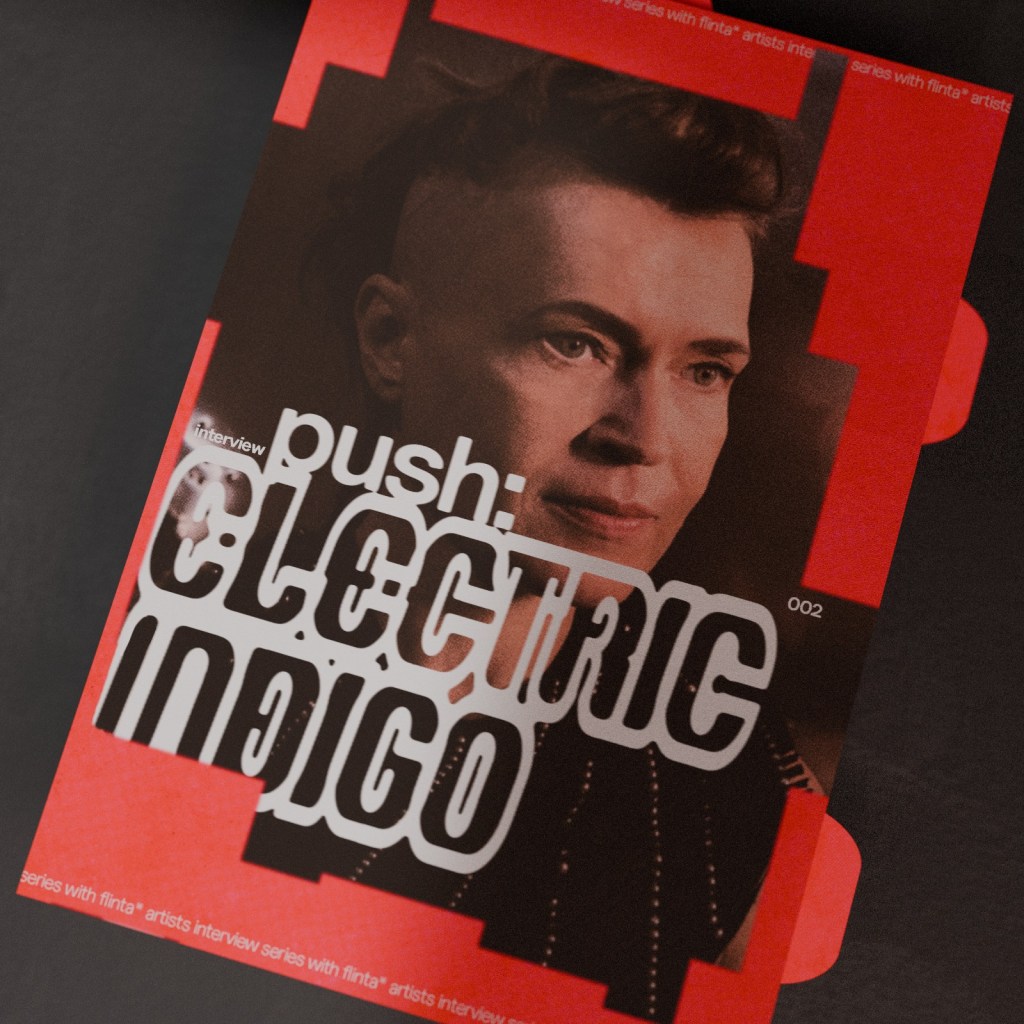
You also worked in radio. How did that influence your career?
Electric Indigo: Alongside DJing, I worked at the radio station Ö3 on the legendary Musicbox program. Initially, I focused on visual arts, but eventually, I started covering techno as well. The response was mixed, to say the least.
A defining moment was when I traveled to Munich — completely broke at the time — to see Underground Resistance perform live. I hitchhiked there just to interview the founding members Mike Banks, Jeff Mills, and Rob Hood for Musicbox. It was an unforgettable experience, but when I returned, the other editors weren’t impressed. They dismissed my approach, saying, “You can’t do journalism like that,” because of my lack of objective distance.
They even declared that Techno was already dead. That was in 1991.
How did you connect with the Techno scene in Germany?
Electric Indigo: I met DJ Hell when he was playing in Vienna. We quickly became friends, and he was incredibly supportive of me as an up-and-coming DJ.
He introduced me to the scenes in Munich and Berlin and later connected me with the Berlin record store Hard Wax.
What was Hard Wax like at that time?
Electric Indigo: Hard Wax was the epicenter of the underground scene — important DJs, labels, and promoters constantly came by.
I knew I wanted to be a part of it, but at first, I was told half-jokingly that they only wanted to hire “good-looking men.” Eventually, I got a foot in the door as a temporary mailorder worker, packing parcels. Without hesitation, I left Vienna and spent the next three years working at Hard Wax, selling records and also buying for the store.
How was it for you as a woman in the techno scene?
Electric Indigo: That period was crucial for me. I built invaluable connections, but I also had to deal with my share of skepticism. Some artists mocked me for having ‘only’ been into Techno since 1991. Even back then, people were nostalgic, insisting that ‘everything was better before.’
But I was determined from the start and set ambitious goals, even if they seemed unrealistic to others.
One of them was playing at Mayday — a goal I reached surprisingly soon after setting it.
You moved back to Vienna in 1996. Did that impact your career?
Electric Indigo: I was worried it might, but fortunately, my career kept growing. For a long time, I was part of the busy international DJ circuit, playing gigs across different continents two or three times every week.
In the 90s, I also started producing music, which opened up a whole new creative dimension for me.
What advice would you give to DJs who are just starting out?
Electric Indigo: It’s important to stay true to your style, even when the environment around you changes.
You also need to be self-confident and believe in yourself — and make sure to project that belief outward.
Set clear goals for yourself, and above all, build a strong network within the scene. If you’re just sitting at home alone, gigs won’t come knocking on your door.
 push-Network